
Published Updated VietVisas
How to Get a Vietnam Visa from the USA: 2 Routes Compared
The two ways into Vietnam from the U.S. — the e-visa and the 5-year visa exemption. Who each suits, what you need, what it costs, and the common mistakes.
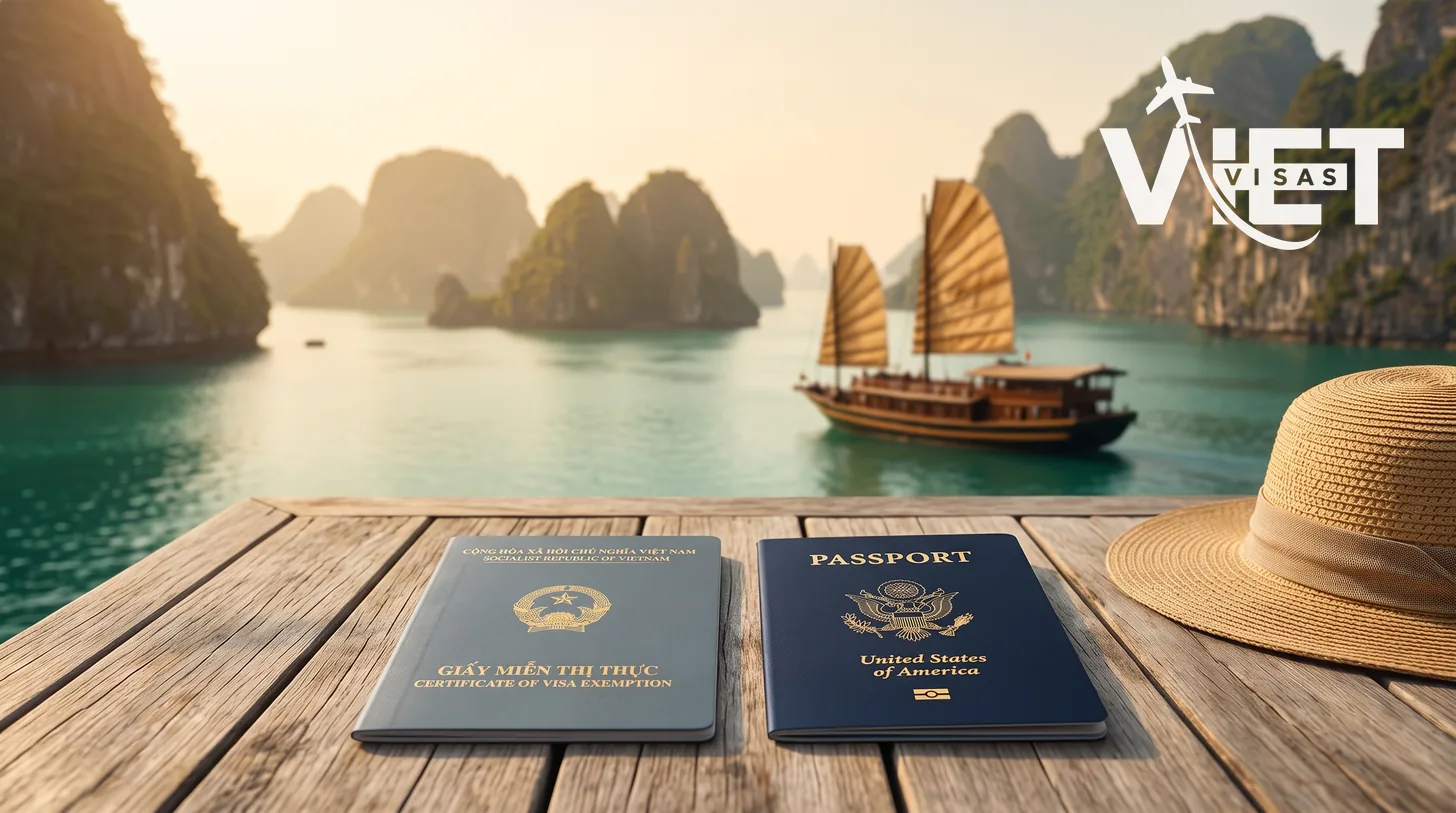
You're in the U.S. and you need to enter Vietnam. The first question everyone asks is where and how do I apply?
The answer depends on who you are, not on whether you're traveling for leisure or business. For most Vietnamese people in the U.S. there are two routes — and picking the wrong one is the most common reason people pay twice.
Note: rules and fees change. This is general information — confirm current requirements before you file.
The short answer
| If you are | The right route |
|---|---|
| A foreign national, or an overseas Vietnamese who doesn't qualify for the exemption, visiting or seeing family | E-visa |
| Of Vietnamese origin, or the spouse or child of a Vietnamese citizen | The 5-year visa exemption — usually the better option |
If you're in the second group, read the visa exemption section below first. Many people of Vietnamese origin buy an e-visa trip after trip for years without realizing they qualify for a document that lasts five years.
Route 1 — The e-visa
The fastest and most common route for short stays.
What it is: an electronic visa issued by Vietnam's Immigration Department. It arrives by email — print it and present it on arrival. No embassy visit or visa sticker in your passport.
Who it suits: foreign nationals visiting, seeing family, or on short business trips — and overseas Vietnamese holding a foreign passport who don't qualify for the exemption.
Where to apply: the Immigration Department's official portal, https://evisa.gov.vn/ (thithucdientu.gov.vn is also official; the old address evisa.xuatnhapcanh.gov.vn moved there in November 2024). It's processed by immigration authorities in Hanoi, not by the Embassy — so don't send an e-visa application to the Embassy.
How long: stays of up to 90 days, single or multiple entry depending on the type.
What you need: a photo of your passport information page (valid at least 6 months), a white-background portrait photo, and basic trip details — intended entry date and port of entry.
The government fee: under the current schedule (Circular 28/2026/TT-BTC, in force since 1 April 2026), an e-visa costs $25 single entry and $50 multiple entry for validity up to 90 days. You pay it on the portal as you file, and it goes to the state — not to any service company.
File it yourself, or have it handled?
You can absolutely file this yourself on the official portal, and if your case is straightforward there's no reason to pay anyone. When you file yourself, you pay the $25 government fee (single entry) and do every step.
Here's what each fee covers:
| How you file | You pay | What that covers |
|---|---|---|
| Yourself, on the portal | $25 (single) or $50 (multiple, up to 90 days) | The government fee. You complete, check and track it yourself |
| Through VietVisas | $65 all-in, single entry | Includes the $25 government fee, plus the checking and follow-through. Multiple entry quoted separately |
When you file yourself, you don't have someone checking your application first or someone keeping track of processing time. Those are the two parts of VietVisas's e-visa service:
- Usually 4 business days. Vietnam Immigration decides whether to approve each visa — VietVisas is not a government agency and does not promise approval; our part is filing it right and following it through.
- Every detail verified before submission — name exactly as it appears in the passport, passport expiration date, intended port of entry, photo quality. Errors in these details are precisely why e-visa applications get rejected.
- If you need it sooner, there is an emergency e-visa at $250, processed in about 1 hour.
The review is worth paying for because the fee generally isn't refunded if an e-visa application is rejected. You lose the money and the time, and you start again — while the flight date doesn't move.
Common failures here: listing the wrong intended port of entry, a photo of the passport with glare or a clipped corner, and a name that doesn't match the passport exactly — middle names and surname order included.
Route 2 — The 5-year visa exemption
This is the route a lot of Vietnamese-Americans miss entirely.
It isn't a visa. It's a certificate confirming you're exempt from needing one — issued once, valid up to 5 years, unlimited entries, and a stay of up to 180 days each time.
Who qualifies:
- People of Vietnamese origin holding a U.S. passport or Green Card, with proof of Vietnamese roots.
- The spouse or child of a Vietnamese citizen, or of an overseas Vietnamese.
What counts as proof of Vietnamese origin: usually a birth certificate, an old Vietnamese passport, or civil-status documents recording Vietnamese origin. Not everyone still has them — if yours are lost, or the names don't match across documents, ask before you start.
The 5-year visa exemption is currently $60 (usually $65), done in 2 business days.
On citizenship: U.S. citizens who are not of Vietnamese origin and not married to a Vietnamese citizen don't qualify — you'll be on Route 1.
Head to head: e-visa or exemption?
| E-visa | 5-year exemption | |
|---|---|---|
| Who can use it | Almost anyone | Vietnamese origin + spouse, children |
| Valid for | That trip | 5 years |
| Length of stay | Within the visa's validity, up to 90 days | Up to 180 days per visit |
| Entries | As applied for | Unlimited |
| Government fee | $25 single / $50 multiple | Per the consular fee schedule |
| Price via VietVisas | $65 per trip (the $25 fee included) | $60 once, for 5 years |
The arithmetic is simple: if you expect to visit Vietnam more than once in the next few years and you qualify, the exemption is cheaper from the second trip onward — and each visit can be twice as long.
That's why your first question should be "Do I qualify for the exemption?" rather than "Where do I apply for a visa?"
So which route?
Two questions, in order:
1. Are you of Vietnamese origin, or the spouse or child of a Vietnamese citizen? If yes → look at the 5-year exemption first. Don't assume you need a visa at all.
2. If not → the e-visa. Fastest, entirely online, delivered by email.
Going to work, study, or stay long-term? Neither route above covers those purposes — you'll need a different visa type. Message VietVisas and we'll point you to the right one for your situation.
Common mix-ups
- Sending an e-visa application to the Embassy. E-visas are handled by immigration in Hanoi through their own portal.
- Filing through a lookalike site. The official portal is
evisa.gov.vn(orthithucdientu.gov.vn). Several sites resemble it closely — some charging many times the government fee. - Being of Vietnamese origin and still buying an e-visa every trip for years, instead of one exemption covering five years.
- A passport with under 6 months left at the intended entry date.
- Listing the wrong port of entry on the e-visa.
- A name that doesn't match the passport — very common where a Vietnamese name carries diacritics and the U.S. passport doesn't.
- Leaving it until just before the flight. Emergency processing exists, but it costs considerably more than planning ahead.
FAQ
Do Americans need a visa for Vietnam? U.S. citizens generally need an entry document, unless they qualify for a visa-exemption certificate — that is, people of Vietnamese origin, or the spouse and children of a Vietnamese citizen.
How long can I stay on an e-visa? Up to 90 days, single or multiple entry depending on the type. The 5-year exemption allows up to 180 days per visit.
What does an e-visa cost in fees? The government fee is $25 for a single-entry electronic visa and $50 for a multiple-entry one valid up to 90 days (Circular 28/2026/TT-BTC). If someone charges you more than that, the difference is their service fee — ask which is which before paying.
Can I file the e-visa myself? Yes. The official portal is open to individuals, and you pay only the government fee. A service is only worth it if you want someone to check your application first or follow up on it.
How long does an e-visa take? If you file yourself, the timing depends on the processing authority. Through VietVisas, the $65 service usually takes 4 business days, with an emergency option in about 1 hour.
Is a rejected e-visa fee refunded? Generally not. That's why it's worth checking the file carefully before submitting.
Do children need their own documents? Yes. Anyone with their own passport needs their own entry document, including young children.
Not sure which group you're in? Message VietVisas with your passport details and family situation — we'll tell you which route to take, including when it's one you can do yourself for free.