
Published Updated VietVisas
How to Renew a Vietnamese Passport in the U.S.: Steps and Timing
Replacing a Vietnamese passport from the U.S.: where to file, what goes in the file, filing yourself vs a service, and what gets a file returned.
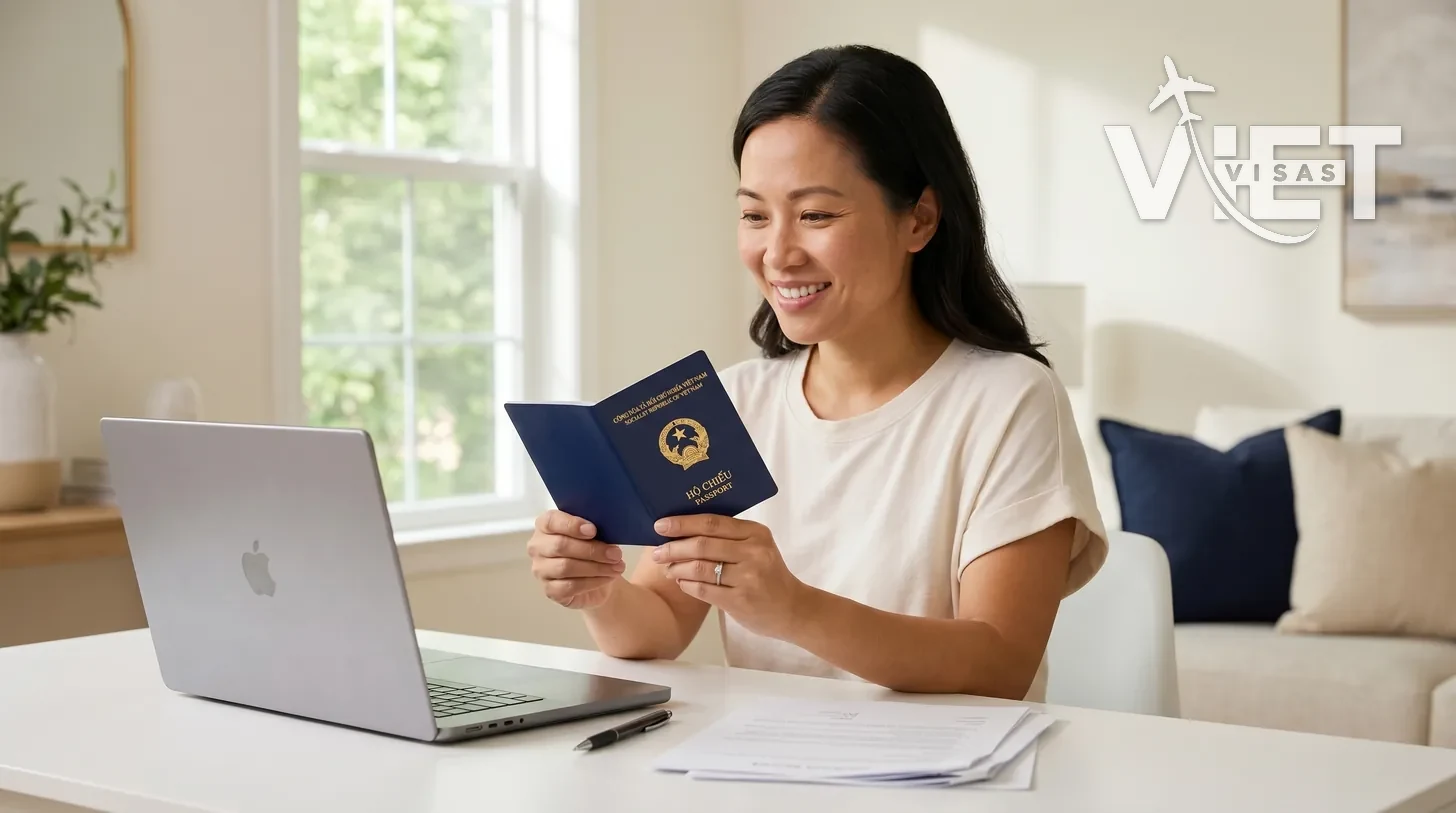
Is your Vietnamese passport about to expire — or already expired — while you're living in the U.S. and unable to travel home? The whole thing can be done from the U.S., without flying back. This guide covers the official procedure, the documents, the two ways to file, special cases, and what gets a file returned.
Note: requirements differ between Vietnamese missions and change over time. What follows is based on the published guidance of the Embassy of Vietnam in the United States and the Consulate General in San Francisco (checked 15 September 2026), and is for reference.
"Renew" or "replace"? Understand it to get it right
First thing to be clear about: a Vietnamese passport cannot be renewed. An ordinary passport is valid for no more than 10 years from its issue date, and no time is ever added to the old booklet. Under the published procedure, a passport that is still valid can be re-issued, and one that has expired requires an application for a new one.
People still say "renewing my passport", and whichever term you search for, the procedure is the same one: you receive a new booklet with a new number. An adult passport (age 14+) is typically valid for 10 years; children under 14 get their own passport valid for 5 years and cannot be included on a parent's passport.
When should you get a new passport?
- Your passport has less than 6 months before it expires — many countries and airlines require at least six months' validity from your entry date.
- Your passport has already expired — it's still replaced as normal; you don't lose your citizenship.
- The passport has run out of stamp pages.
- Your personal details changed — a name change after marriage, or adding a new citizen-ID number.
- You're about to travel to Vietnam or handle paperwork that needs a valid passport.
Don't wait until close to your travel date. Processing time is one thing, but having to supply more documents halfway through can derail your plans.
Which case are you?
The published procedure splits into separate categories, and starting in the wrong one is a common reason a file has to be redone:
| Situation | Procedure | Note |
|---|---|---|
| Still valid, or expired recently | Re-issuance | The most common case |
| Already expired | New issuance | Similar process, may need extra documents |
| Lost or badly damaged | New issuance after loss | Requires a loss report — see replacing a lost passport |
| Never held a Vietnamese passport | First-time issuance | Needs proof of citizenship and a personal history form |
| For a child under 14 | The child's own passport | See passports for children |
What goes in the file
A re-issuance application usually needs four types of documents:
- The application form in the mission's own format.
- Your current Vietnamese passport and copies of its first pages.
- Proof of lawful U.S. residence — a green card, U.S. passport, or certificate of U.S. citizenship; students use an I-20; without a residence permit, a copy of the I-94 with an explanation.
- Passport photos, 2x2 inches, white background, facing the camera, no hat, no dark glasses — that is the specification when you file yourself; through VietVisas any background is fine, as we correct it.
To add a new name or a new citizen-ID number to the passport, include a copy of the supporting document and state the request on the form; there may be an extra fee for it.
Exact requirements differ by category and by mission — read the guidance of the office you're actually filing with, or ask before you send anything.
Need the photos to come out clearly? See our guide to photographing documents at home with a phone.
Filing: in person or by mail
In person, at the mission covering where you live. For children aged 16 and under, a parent may attend on their behalf, bringing their own ID and the child's birth certificate.
Filing by mail comes with some easily overlooked requirements:
- U.S.-issued documents must carry an apostille from the Secretary of State of your state. Without one they aren't treated as valid.
- You must enclose a prepaid certified-mail envelope with the return address. The guidance says explicitly not to use FedEx Ground or UPS Ground, as those aren't certified services.
- Supporting documents are generally submitted as the original plus one copy.
- Fees are paid by money order, cashier's check, certified check, or cash in person — not by card.
- An invalid file is returned only if a return envelope was enclosed; without one, it isn't processed.
Which is why many people use a service — not because the procedure is mysterious, but because one small error at the mailing stage sends the whole file back to the start.
Special cases
- The name on your U.S. passport or green card differs from your Vietnamese passport. The U.S. form of your name can be added to the observation page of the new passport, usually for a small fee.
- A passport that expired long ago. Still fine — there's no point at which you lose the right. An older handwritten passport may require additional documents and a more thorough identity verification, so it takes longer than a printed one.
- A name change after marriage or divorce. You'll need proof of the change so the new passport matches your current U.S. documents.
- Children. A child's file needs a birth certificate and the parents' documents; a child born in the U.S. usually has to be registered with the mission first, and only then apply for a passport.
- The new design has no signature or seal on the data page. That's the current standard, not a printing fault — see why the new passport has no signature or seal.
Mistakes that slow a file down
- A headshot that doesn't meet the specification — glasses, a hat, poor lighting, or wrong framing.
- Blurry photos of the passport — clipped corners, glare, unreadable details.
- Starting in the wrong category — for instance filing a lost passport as a re-issuance.
- U.S. and Vietnamese names that differ, with nothing prepared to explain it.
- Mailing it in without the apostille, or without a prepaid return envelope.
- Leaving it until just before the flight, which turns every small error into a big one.
Timing: two clocks, not one
- Processing time — from a complete file to approval.
- Shipping time — from the mission to your door.
If you're doing it yourself, add the time you spend gathering documents and mailing them in both directions. Count backward from your departure date and leave a few days' margin, especially around Vietnamese or U.S. public holidays.
If you'd rather someone did it for you
Through VietVisas's passport renewal service you send photos, a specialist checks and completes the file, submits it, tracks it, and the new passport is delivered to your door. Your original passport stays in your hands, and you pay only after the application is approved — from $175, with processing in 2–3 business days.
And if your case is straightforward and the travel doesn't bother you, filing yourself is perfectly doable — the guidance above is enough to start.
After your new passport arrives
Check the full name, date of birth and passport number as soon as you open the package; report anything wrong early, because late corrections are always harder.
Two things commonly follow a passport replacement:
- If you hold a visa exemption certificate issued for the old passport, it's tied to that old number — you'll need to apply for a new one linked to the new passport.
- If you travel to Vietnam often and don't have one yet, this is a sensible moment to get it.
Frequently asked questions
Can a Vietnamese passport's validity be extended? No. An ordinary passport runs for a maximum of 10 years and cannot be extended — you're issued a new one.
Do I have to mail my original passport? Filing by mail yourself, yes, as the file requires. Through VietVisas, no — you only send photos.
How long is the new passport valid? Ages 14 and over, typically 10 years; children under 14, five years.
Can my U.S.-born child get a Vietnamese passport? Yes, if the child holds Vietnamese citizenship; usually birth registration at the mission comes first. See passports for children.
What if my U.S. name differs from my Vietnamese passport? The U.S. form can be added to the observation page of the new passport; state the request on the application form.
I still hold a valid Vietnamese passport — can I get a visa exemption certificate? No. Anyone holding a valid Vietnamese passport isn't eligible for one; simply travel on the passport.
Need it quickly, or does your case have a complication? Message VietVisas — reviewing a file is free, including when the answer is that you can do it yourself.
Sources
Related post on VIET VISAS Facebook.