
Published Updated VietVisas
Affidavit of Single Status in the USA: The Complete Guide to Marrying in Vietnam
The document set the Vietnamese Embassy lists for marriage registration, which papers need notarization and state authentication, the 6-month rule, and DIY costs.
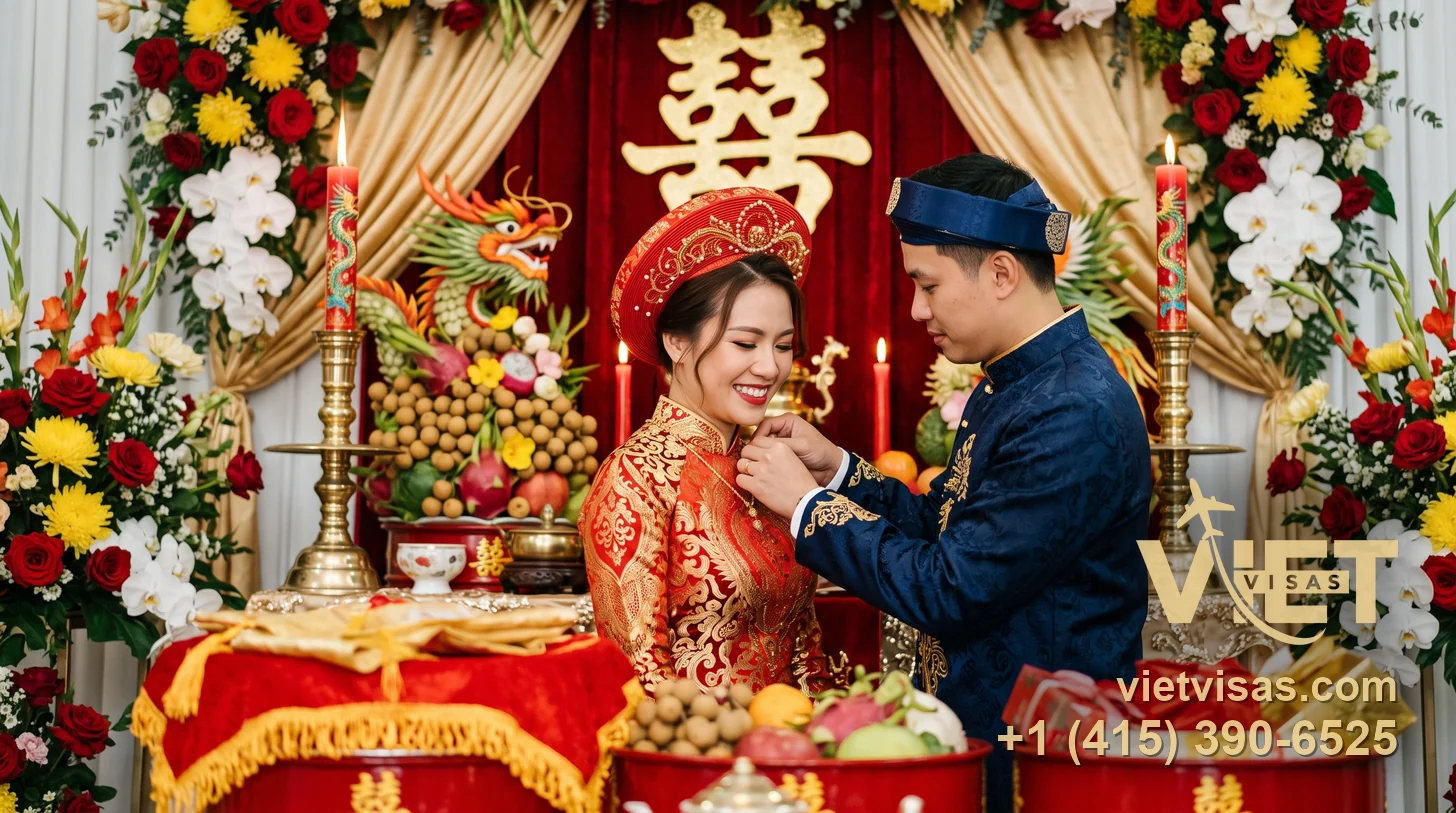
You live in the U.S. and you're about to marry a Vietnamese citizen in Vietnam. One of the most important parts of the file is proof of your marital status — what the Vietnamese community calls a công hàm độc thân.
Many people assume you walk into a U.S. government office, request a "Certificate of Single Status," and you're done. In reality, the United States does not issue a single nationwide single-status certificate. Depending on your circumstances and where you live, the file consists of several documents, each taking a different certification path.
This guide covers the whole process, from preparing the papers in the U.S. to filing them in Vietnam.
Note: requirements can change by case, by state, and by the Vietnamese office registering the marriage. This is general information, not a substitute for guidance from the relevant authority.
What "công hàm độc thân" actually means
It's a colloquial name for a set of documents, not one certificate. The two most often confused are:
Affidavit of Single Status — your own sworn statement about your marital status, signed before a Notary Public: never married, divorced, or previously widowed and not remarried.
Certificate of No-marriage Records — issued by a state or county vital statistics office, confirming no marriage record was found in your name over a specified search period.
These do not substitute for each other. One is your statement; the other is a government search result. The file generally needs both.
What's in the file
The file generally includes the following — the first seven come from the Embassy of Vietnam in the United States' published list for legalizing marriage-registration documents:
- Application for Marriage Registration in Vietnam — with photo and applicant's signature
- Affidavit of Single Status
- Certificate of No-marriage Records
- Certificate of Good Mental Health — from an authorized medical organization
- Biographic Information Sheet
- Passport copy — photo and signature pages, certified a true and exact copy of the original
- Power of Attorney
- Statement of Non-Impediment to Marriage
If you were previously married, add the Divorce Decree or the Death Certificate of the late spouse.
No two cases are identical. Someone never married has a different file from someone divorced, someone who changed their name, or someone previously married in Vietnam.
The detail most people miss: not every document takes the same path
This is what sends files back.
Per the Embassy's guidance, documents 1, 2, 4, 5 and 6 must go through the full chain:
Notary Public → authentication by your state's Office of Authentication / Secretary of State → legalization at the Embassy
But document 3 — the Certificate of No-marriage Records — does not. It comes already certified by the Registrar or Court Clerk who issued it, so it doesn't need notarizing again.
The statement of non-impediment (document 8) also goes through these steps.
Taking document 3 to a notary is wasted effort; skipping the chain on the others leaves the file incomplete. Both cost you time.
The 6-month rule — and which document it applies to
The Certificate of No-marriage Records must have been issued within the last six months when you file. This is the tightest deadline in the whole set.
The search period is specified too:
- From the age of majority — given as 18 for women and 20 for men — through the present;
- Or from the divorce or the spouse's death through the present, if you were previously married.
So timing matters in both directions:
- Start too early: it expires before you can file in Vietnam.
- Start too late: there isn't room for county → notary → state authentication → legalization → shipping to Vietnam.
The safe approach is to count backward from your intended filing date in Vietnam, leaving room at every stage.
Step by step
Step 1 — Request the Certificate of No-marriage Records
The issuing office may be the County Clerk, Vital Records, or an equivalent, depending on where you live. The process is not the same in every state.
Before applying, check: which office has authority, the required search period, the form, the fee, how to submit, processing time, and whether a copy of your ID is required.
Start this one first — its timing is the part you control least.
Step 2 — Prepare the Affidavit of Single Status
The details must be accurate and consistent with your identity documents: full legal name, date of birth, nationality, address, passport details, current marital status.
For Vietnamese-Americans, check the name with particular care — there are often several versions in circulation: the name on a Vietnamese birth certificate, on a U.S. passport, after naturalization, before and after marriage, and after a court-ordered name change.
Where documents disagree, you'll need something establishing that the different names belong to the same person.
Step 3 — Sign before a Notary Public
This is where people most often go wrong. Bring the document unsigned and sign in front of the notary — signing at home usually means doing it again.
Afterward, check the signature, the notarization date, the seal, the notary's details, the expiration date of the notary's commission, and the certificate wording. A small error here invalidates everything you do after it.
Step 4 — State-level authentication
The document then needs your state to verify the notary's signature and authority.
Every state differs. Some require County Clerk verification first, before the Secretary of State will process it — don't apply one state's process to another.
Before mailing originals, check: whether County Clerk authentication is needed first, whether there's a specific form, the fee, whether you submit in person or by mail, processing time, and whether a return envelope is required. If you're mailing originals, always use a tracked service.
Step 5 — Consular legalization
The state-authenticated documents are then legalized so they can be used in Vietnam.
The sequence is fixed:
Notary → state authentication → legalization / Apostille as applicable → file in Vietnam
Don't rearrange it.
How long: the Embassy's guidance puts legalization of marriage-registration documents at 5–7 working days for regular processing, or 2–3 working days for rush, counted from the date the papers are received. Fees are paid by money order or cashier's check, and a prepaid, tracked return envelope must be enclosed — the guidance says to use only FedEx or USPS Express Mail.
Step 6 — Send the file to Vietnam
File with the authority registering the marriage, together with your partner's documents.
Specific requirements depend on the locality. Have your partner check with the receiving office first — sending a missing document from the U.S. costs weeks. If your file includes other papers for use in Vietnam, see consular legalization.
Apostille and the 11 September 2026 change
Vietnam deposited its instrument of accession to the 1961 Apostille Convention on 31 December 2025. According to the HCCH, which administers the Convention, it entered into force for Vietnam on 11 September 2026.
That changes how some foreign public documents are certified for use in Vietnam. But it's worth being precise about what an apostille is:
An apostille is not a certificate that the contents are correct. It verifies the document's origin — the signature, the capacity of the signatory, and the seal.
So now that it is in force, do not assume that any document with an apostille attached can simply be filed with any office in Vietnam. Whether a particular document works still depends on its type, the issuing authority, the receiving office in Vietnam, and the implementing rules in force when you file.
Consular legalization remains valid — anything already legalized keeps its effect, and it stays the route VietVisas handles for you.
If you're divorced or widowed
Divorce Decree — the court's final judgment or order, notarized and state-authenticated like the rest.
Death Certificate — for a late spouse, added per the file's requirements.
Recording the divorce in Vietnam — if the earlier marriage was registered in Vietnam but the divorce happened abroad, you may need the divorce recorded in the Vietnamese civil register before a new marriage can be registered. Check this early; discovering it late adds considerable delay.
Can I do this while in Vietnam?
You may be able to swear the affidavit at a U.S. diplomatic mission in Vietnam, but the file and the subsequent handling still have to satisfy the registering authority.
In many cases, if your underlying documents are in the U.S., preparing everything stateside first leaves you more in control.
A worked example: what DIY costs in California
Fees vary by state. Taking California as an example, at the rates published as of writing:
| Item | Fee | Notes |
|---|---|---|
| Marriage record search | $19 | From 1 Jan 2026 under AB 64. If no record is found, the office issues a Certificate of No Public Record and keeps this as the search fee |
| Notary Public | $15 per signature | California's statutory maximum — a notary may charge less |
| California Secretary of State authentication | $20 per document | Plus $6 special handling per different public official's signature for in-person requests |
| Consular legalization | $170 per document | This is VietVisas's price for that step alone — the Embassy does not publish its own fee on its website |
| Tracked overnight shipping | about $36–46 per leg | USPS Priority Mail Express flat rate $35.90; FedEx One Rate Standard Overnight $39.90–$45.70 by zone |
The cost depends on the number of documents: six — documents 1, 2, 4, 5, 6 and the statement of non-impediment — need both a notary and state authentication. In California that's:
- Notary: 6 × $15 = $90
- Secretary of State: 6 × $20 = $120
- Marriage record search: $19
- Consular legalization: $170
- Overnight shipping: at least 4 legs (outbound and prepaid return for both the Secretary of State and the legalizing office) ≈ $144–183
Roughly $543–582 in total.
Put another way: you run almost the entire process yourself, spend weeks doing it, risk having to redo the paperwork — and still end up at about $500 or more, which is what the full-service option costs.
And that's the simplest case. Every additional document that has to travel the notary + state authentication chain adds roughly $35 — a divorce decree if you're divorced, or a name-change order.
On timing, the Embassy publishes legalization at 5–7 working days normally, or 2–3 working days for rush. That is one leg of the chain — before the county's and the Secretary of State's own queues, plus mail time between each stage.
The search, notary and Secretary of State figures are published California government fees as of writing. The legalization line is VietVisas's service price, not a government fee. Check your own state's current rates before you begin.
Is doing it yourself hard?
Nothing requires you to use a service. With time, you can absolutely prepare the file yourself — the guide above is enough to get you through.
The hard part isn't signing an affidavit. The hard part is getting all of this right at once:
Right documents → right offices → right order → right certifications → still valid on the day you file.
The five most common failures:
- Requesting the wrong "no marriage record" document — the name and issuing office differ by state.
- Signing the affidavit before meeting the notary.
- Skipping state authentication, or skipping the County Clerk in states that require it first.
- Names that don't match across documents — especially common after naturalization.
- Starting too early, so the 6-month window closes before you file.
What these share: you usually only find out at the last stop, when the office in Vietnam hands the file back — and by then the originals are in Vietnam and have to travel back.
Checklist
- U.S. passport or green card
- Application for Marriage Registration
- Affidavit of Single Status
- Certificate of No-marriage Records (issued within 6 months)
- Certificate of Good Mental Health
- Biographic Information Sheet
- Certified copy of passport
- Power of Attorney, if you're not filing in Vietnam in person
- Statement of Non-Impediment to Marriage
- Divorce papers, if previously married
- Death certificate of a late spouse, if applicable
- Name-change order, if any
- Notary Public certification
- State-level authentication
- Legalization / Apostille as applicable
- Your partner's documents in Vietnam
Or have VietVisas handle it — $500 per set
If you'd rather not work through each office yourself, VietVisas runs the whole thing:
- $500 per set, including FedEx from the consulate to your door. No separate charges for each stage.
- Done in about 3–5 days, instead of weeks of mail going back and forth.
- You pay only after the consulate has confirmed and a FedEx tracking number is on its way to you — by Zelle or Venmo. No deposit, nothing upfront.
- Your file is checked before anything starts, so you don't have to redo the paperwork because of a mismatched name or steps taken out of order.
Covers: file review, document guidance, preparing the affidavit, notarization, state authentication, legalization, tracking, and return by FedEx.
Why review the file first? Every case differs — never married, divorced, widowed, name changed, Vietnamese and U.S. documents with conflicting details, or a previous marriage registered in Vietnam. Rather than start producing documents and discover a gap later, send photos of what you have and we'll identify the right set for your situation.
Message VietVisas — consultation is free. 📞 +1 (415) 390-6525 · 💬 Zalo +1 (415) 939-7514 · 📧 support@vietvisas.com
FAQ
Is the công hàm độc thân the same as an Affidavit of Single Status? Not exactly. The affidavit is your sworn statement. "Công hàm độc thân" is the common name for the whole set of documents proving marital status.
Does the U.S. issue a Certificate of Single Status? There's no such document issued uniformly nationwide. The file uses an Affidavit of Single Status together with a Certificate of No-marriage Records and supporting papers.
I've never been married — do I still need the Certificate of No-marriage Records? Yes. The Embassy lists it in the dossier for marriage registration with a Vietnamese citizen, including for applicants who have never married.
Does that certificate need notarizing? No. It arrives already certified by the Registrar or Court Clerk who issued it — unlike the affidavit and the other documents.
How long does it take? It depends on your state, your county, and each office's processing time, plus authentication, legalization and shipping. Through VietVisas, the work in the U.S. is typically completed in about 3–5 days.
Since 11 September 2026, is consular legalization still needed? Vietnam formally joined the Apostille Convention that day. How it applies in practice still depends on the document type and the receiving office — don't assume every file needs only an apostille without checking.
In summary
Getting an affidavit of single status in the U.S. isn't simply requesting a "single certificate." You need the right documents, in the right order, still valid when you file:
Request proof of marital status → affidavit → notary → state authentication → legalization / Apostille → send to Vietnam → file for marriage registration
If your case has complications — divorced, widowed, a name change, or a previous marriage registered in Vietnam — check before you start, so you don't have to start again.
This information is provided for reference. Rules and document requirements change over time, by state, and by receiving office. Please confirm current requirements before filing.