
Apostille and Consular Legalization of U.S. Documents
From $170Apostille for U.S. documents used in Vietnam, recognized since 11 Sep 2026 — or consular legalization when an office asks. Birth, marriage, diplomas. From $170.
- No originals needed in most cases
- Tracked overnight shipping, free both ways
- Bilingual specialists · replies 24/7
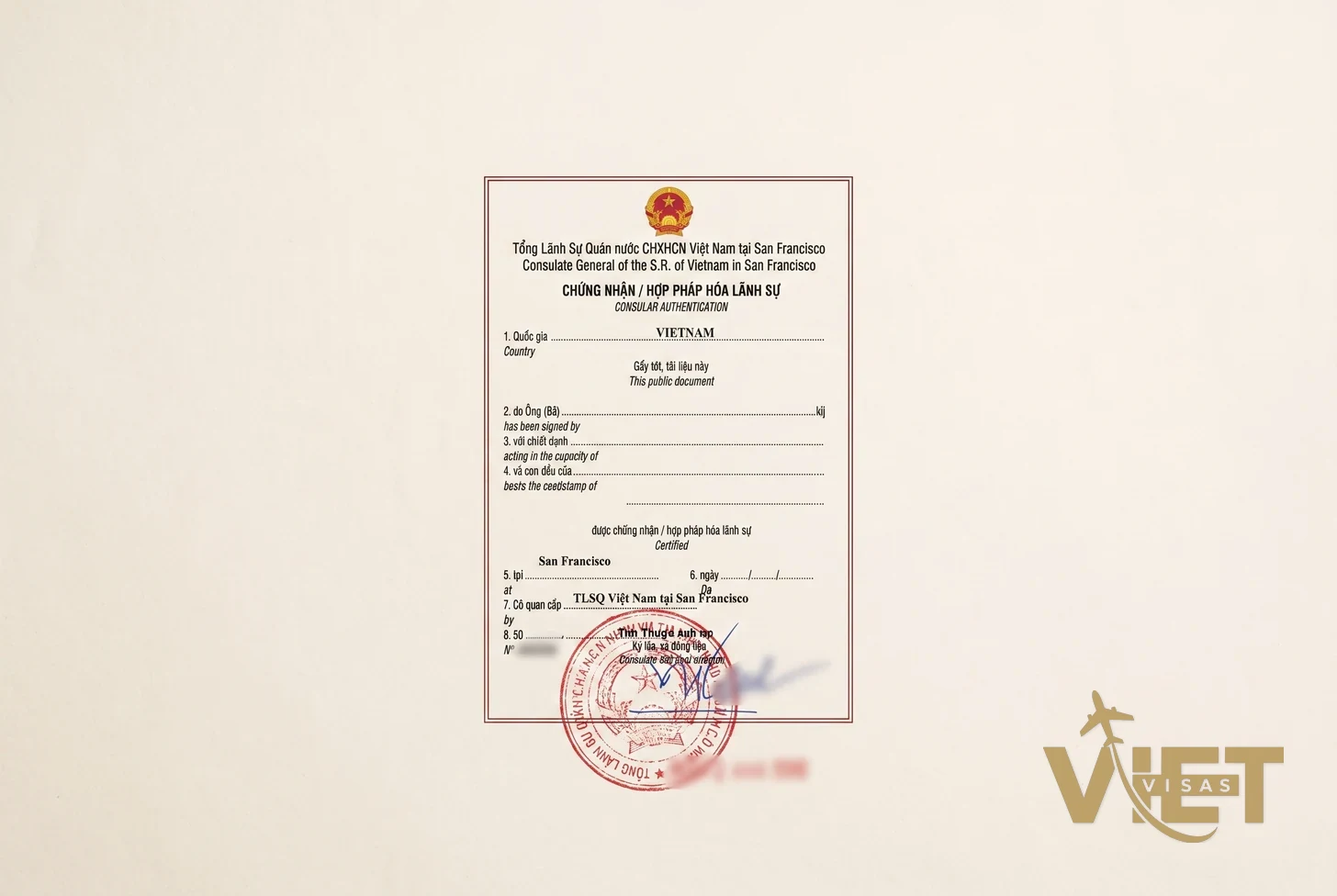
- Price
- from$170
- Processing
- 3–5 days(business days)
- You receive
- Tracked overnight delivery, free to all 50 states
- Payment
- After you receive the result · Zelle, Venmo or card
Do you have a U.S.-issued document you need to use in Vietnam? Since 11 September 2026, most U.S. public documents need only an apostille to be recognized there — no consular processing step is needed. When the receiving office still asks for consular legalization, VietVisas does that instead. Both are handled end to end, from $170.
What is an apostille?
An apostille is a single certificate, issued in the U.S. by the competent U.S. authority, confirming that the signature, capacity and seal on a document are genuine. Vietnam joined the 1961 Apostille Convention, which entered into force for Vietnam on 11 September 2026; the United States has been a party since 1981.
Three things to remember:
- An apostille confirms origin, not content. The receiving office in Vietnam still reviews what the document says.
- An apostille doesn't replace notarization. Private documents (signatures, copies) still need to be notarized before they can receive an apostille.
- An apostille doesn't expire — but it must never be detached from the document.
Apostille or consular legalization: which route does your document take?
| Situation | Route |
|---|---|
| A U.S. public document used in Vietnam: birth or marriage certificate, divorce decree, background check, diplomas and notarized documents | Apostille |
| The receiving office in Vietnam specifically asks for consular legalization | Consular legalization |
| Administrative documents dealing directly with commercial or customs operations (outside the Convention) | Consular legalization |
| A document legalized before 11 September 2026 | Still valid, no need to redo it |
| An affidavit of single status for marriage registration | VietVisas's $500 package uses consular legalization — see affidavit of single status |
Not sure which applies to your document? Send VietVisas a photo — we'll look and tell you the right route before you spend anything.
The process — in the right order
The apostille route
- Notarize if it's a private document: a power of attorney, a sworn statement, a copy of a diploma. A certified copy issued by a vital records office usually needs no extra notarization.
- Get an Apostille from the Secretary of State of the same state that issued or notarized the document. For federal documents — such as an FBI background check — from the U.S. Department of State.
- Translate into Vietnamese when the receiving office asks — see certified translation.
The consular legalization route
- Notarize if needed.
- State certification at the Secretary of State.
- Consular legalization at a Vietnamese representative office in the U.S.
- Translate into Vietnamese if needed.
Doing the steps out of order, or getting the apostille from the wrong state, are the most common reasons files get returned. See: 5 mistakes that get legalization rejected.
Common apostille mistakes
- The wrong state. A document notarized in California needs a California apostille, even if you now live in Texas.
- Detaching the apostille from the document to photocopy it — once separated, the apostille is void.
- Skipping notarization for a private document: the Secretary of State only apostilles the signature of a notary or a public official.
- Using a document that's too old when the receiving office wants a recent one, even though the apostille itself doesn't expire.
- Not checking with the receiving office first. Some offices in Vietnam may ask for extra documents or a translation.
Documents that usually need an apostille or legalization
- Birth and marriage certificates, divorce decrees, death certificates
- Diplomas, transcripts, certificates
- Criminal background checks, including FBI background checks
- Powers of attorney and notarized statements
Many Vietnamese offices also require an accompanying Vietnamese translation — see certified translation.
Cost & why choose VietVisas
The service fee is from $170, for an apostille or consular legalization — whichever your document needs. VietVisas identifies the right process and office for each document and completes the steps in the correct order. We serve the whole U.S. and deliver results free to your door in all 50 states, so you don't have to go from office to office.
Not sure whether your document needs an apostille or consular legalization? Message VietVisas for a free consultation.
We accept
Frequently asked questions
- If I have an apostille, do I still need consular legalization?
- Usually not. The Apostille Convention entered into force for Vietnam on 11 September 2026, so U.S. public documents carrying an apostille are recognized there. Consular legalization is needed only when the receiving office in Vietnam specifically asks for it, or for document types outside the Convention. Anything legalized before that date keeps its full effect.
- Where do I get an apostille in the U.S.?
- For a document issued or notarized in a state, from that state's Secretary of State (a few states use another office, such as the Lieutenant Governor in Alaska, Hawaii and Utah). For a federal document, such as an FBI background check, from the U.S. Department of State's Office of Authentications. VietVisas works out the right office for each document.
- Does an apostille expire?
- No. An apostille doesn't expire. The receiving office may still want the document itself to be recent — a recently issued background check, for example.
- What's the correct order of steps?
- Apostille route: Notarize (if needed) → Apostille → Translation (if the receiving office asks). Consular legalization route: Notarize (if needed) → State certification → Legalization at a Vietnamese representative office → Translation. Doing it out of order usually means starting over.
- Should I do it in the U.S. or wait until I'm in Vietnam?
- Do it while you're in the U.S. An apostille can only be issued in the country that issued the document; if you discover something missing after arriving in Vietnam, you'll have to ship documents back to the U.S. — costing time and money.
Updated VietVisas
Sources
Ready to get started?
From $170 · all-inMost cases are done in 3–5 business days and delivered free to all 50 states — and in most cases you keep your original documents.
- No originals needed in most cases
- Tracked overnight shipping, free both ways
- Bilingual specialists · replies 24/7